Knee pain that continues beyond an expected healing period is not automatically arthritis, and an MRI finding is not automatically the cause. By matching the pain pattern with the examination, injury history, activity load, and warning signs, you can identify which problems need home changes, structured treatment, imaging, or prompt medical care.
Key takeaways
- Pain location and triggers help distinguish arthritis, tendon, meniscus, and referred pain.
- Hip problems and nerve irritation can cause pain felt around the knee.
- Imaging is guided by examination findings, injury history, and persistent symptoms.
- Start with activity changes and targeted treatment before considering invasive options.
Which common knee problems cause pain that does not go away?
The main persistent knee pain causes are easier to separate by location, trigger, and mechanical symptoms than by pain intensity alone. Osteoarthritis knee pain usually worsens with walking, stairs, or other activity and may include grinding, reduced movement, and stiffness after rest.
In adults aged 45 or over, morning stiffness lasting about 30 minutes or less supports this pattern.
| Condition | Symptom pattern that points to it |
|---|---|
| Osteoarthritis | Activity-related pain, grinding, reduced motion, and brief stiffness after rest |
| Meniscus tear symptoms | Pain along the joint line, catching, swelling, or locking; degenerative tears often accompany osteoarthritis |
| Ligament injury knee instability | Giving way, instability, or swelling after a clear twisting injury |
| Patellar-tendon loading | Pain directly below the kneecap or where the tendon attaches to the shin after jumping, running, or squatting |
| Bursitis | Tenderness and visible swelling over the kneecap, especially after kneeling |
| Patellofemoral pain | Front-of-knee pain during stairs, squats, running, or prolonged sitting |
| Iliotibial-band overload | Pain on the outer knee during running or cycling, rather than general joint wear |
A meniscus tear on an MRI does not automatically require arthroscopy; degenerative tears often reflect the same joint changes causing osteoarthritis, so exercise-based treatment is usually considered first. Patellofemoral pain also does not prove that the kneecap is displaced or that cartilage is damaged.
Load-related tendon and iliotibial-band pain usually reflects repeated stress, not a joint wearing out.
When is persistent knee pain caused by inflammation, the hip, or nerves?
Persistent knee pain is more likely to reflect inflammation than uncomplicated osteoarthritis when you have rheumatoid arthritis knee symptoms such as morning stiffness lasting over 30 minutes, warmth, recurrent visible swelling, or symptoms in several joints. This pattern needs medical assessment rather than repeated self-treatment for “wear and tear.”
Gout knee pain often begins over hours, causing sudden severe pain, marked swelling, redness, and extreme tenderness. Septic arthritis warning signs include a hot, red, very painful knee with fever, chills, or feeling unwell. Seek emergency assessment; do not receive a steroid injection until infection has been excluded.
A hip disorder can produce referred hip pain to knee even when the knee examination is nearly normal. Hip arthritis becomes more likely when knee treatment fails and hip movement, groin pain, or difficulty putting on shoes also causes symptoms.
Lumbar-spine nerve irritation can send burning, electric, tingling, or numb pain toward the knee, with back pain, altered sensation, or weakness.
A Baker’s cyst is usually fluid pushed out by an internal knee problem, such as osteoarthritis or a meniscal disorder. Treating the cyst alone may not prevent recurrence. If it ruptures, sudden calf swelling or pain can resemble deep-vein thrombosis, so arrange assessment rather than assuming it is harmless.
Calf swelling with breathlessness requires emergency care.
How should persistent knee pain be assessed, and when is imaging needed?
The assessment starts with your history, not a scan. The clinician needs to know when pain began, whether a twist or impact occurred, its exact location, swelling pattern, locking, catching, instability, fever, other painful joints, work demands, running load, and previous injuries.
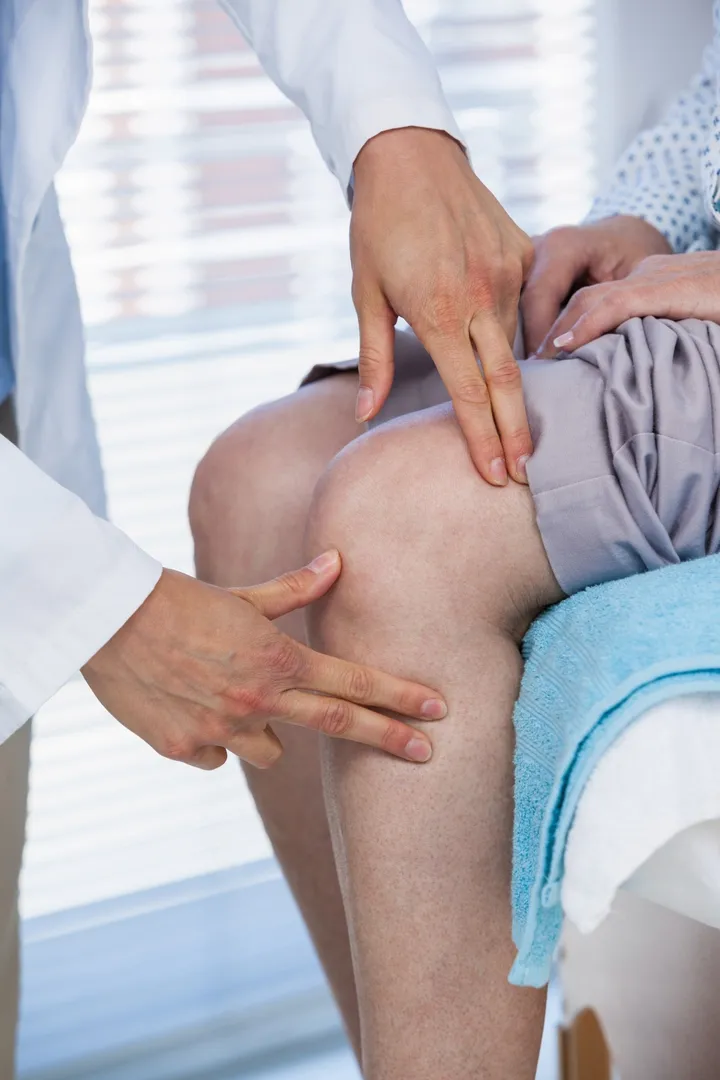
1. During the knee pain examination, you walk, squat, climb steps, and move the hip. The clinician checks alignment, muscle strength, ligament stability, joint motion, and sensation.
2. Imaging is chosen to answer a specific question. For chronic pain without a recent major injury, a plain knee X-ray is usually the first test when imaging is needed. It can show a fracture, alignment change, or established joint-space narrowing.
3. Knee X-ray versus MRI is not a contest between “basic” and “better.” MRI is reserved for persistent symptoms that the examination and X-ray do not explain, or for a specific concern involving a meniscus, ligament, cartilage, bone, or other soft tissue. Incidental meniscal tears are common, so an MRI before examination can misdirect treatment.
A knee ultrasound can assess superficial tendons, bursae, fluid collections, and a Baker’s cyst. It does not replace an X-ray for bone alignment or an MRI for deep internal structures.
4. Seek prompt assessment for inability to bear weight, a locked knee, major deformity, marked instability, sudden severe pain, or swelling after significant injury. A locked knee warrants urgent care because a fracture, major ligament injury, or displaced meniscal fragment may be present. Calf swelling with breathlessness requires emergency care.
What keeps knee pain going, and which treatments are compared first?
Persistent knee pain often continues because the daily load exceeds the knee’s current capacity. Age, an old injury, excess body weight, weak quadriceps or hip muscles, repeated kneeling, a sudden increase in running distance, poor recovery, unsuitable footwear, and training errors can all keep symptoms active.
Do not assume every persistent problem is arthritis, exercise through visible swelling, or self-prescribe pain medicine for weeks without review.
Reduce the aggravating load rather than stopping all movement. Knee strengthening exercises, aerobic activity, and functional exercise are core treatments for osteoarthritis; a temporary discomfort increase does not necessarily mean damage.
- Knee pain physiotherapy can address weakness, balance, gait, and movement errors.
- Weight loss knee osteoarthritis management can reduce symptoms; around 10% body-weight loss generally helps more than 5% when achievable, but it should not delay assessment.
- Braces help selected instability or alignment problems, but they do not repair a torn structure.
- Avoid injections until infection has been excluded. Medication and injections have limits and risks.
| Option | What it offers or cannot do | Compared first when |
|---|---|---|
| Exercise | Improves strength, pain, and function | Osteoarthritis or weakness is present |
| Physiotherapy or brace | Corrects deficits; supports selected instability | Movement or alignment contributes |
| Medication or injection | May relieve symptoms but carries risks | Symptoms persist despite rehabilitation |
| Joint preservation | Targets a defined problem while retaining a usable joint | Joint preservation versus knee replacement is under consideration |
| Replacement | Replaces a joint with advanced, widespread damage | Pain and lost function remain after non-surgical care |
What should you do before booking a knee pain consultation?
A useful knee pain consultation starts with evidence from your week, not an MRI appointment or a fixed diagnosis.
1. Keep a knee pain symptom diary for seven days. Record pain location and severity, walking distance, stairs, squats, sitting time, swelling, locking, giving way, exercise changes, medicines and doses, and morning stiffness duration.
2. Photograph visible swelling and note fever, chills, calf swelling or pain, and any recent injury.
3. Bring previous X-ray or MRI reports, medication names and doses, and details of physiotherapy or injections, including what helped or failed.
4. Until assessed, replace running, jumping, deep squats or kneeling that clearly trigger swelling with cycling or another lower-impact option. Do not immobilise the knee without advice.
During an orthopaedic knee assessment, ask what diagnosis the examination supports, what finding would justify an X-ray, ultrasound or MRI, how long to try physiotherapy, and what would make surgery appropriate.
Shanthi Orthopaedic And Dental Clinic can be useful when you want movement testing, imaging decisions, rehabilitation planning and follow-up considered together rather than receiving an isolated scan.
Know when to seek urgent knee care: go promptly for a hot, swollen knee with fever or chills, inability to bear weight, a locked knee, major deformity or sudden severe pain. Calf swelling with breathlessness requires emergency care.
Related services
Orthopaedic Shanthi Orthopaedic and Dental Clinic Shanthi Orthopaedic and Dental Clinic provides comprehensive evaluation and treatment for patients who may... View service → |
Orthopaedic Joint preservation procedures & surgeries Shanthi Orthopaedic and Dental Clinic Shanthi Orthopaedic and Dental Clinic provides specialized Joint Preservation Procedures & Surgeries focused on... View service → |
Frequently asked questions
Which common knee problems cause pain that does not go away?
Osteoarthritis, meniscus injury, ligament or tendon problems, bursitis, and patellofemoral pain can cause persistent knee pain. Location, activity triggers, swelling, locking, and instability help separate them.
When can persistent knee pain come from the hip or nerves?
Hip arthritis or other hip conditions can refer pain to the thigh or knee. Nerve irritation in the lower back can cause burning, tingling, numbness, or pain that travels into the leg.
How is persistent knee pain assessed, and when is imaging needed?
Assessment includes the pain history, walking pattern, range of motion, strength, swelling, tenderness, and stability. X-rays help assess bone and arthritis; MRI is considered for suspected meniscus, ligament, cartilage, or other soft-tissue problems.
What treatments are compared first for persistent knee pain?
Treatment depends on the cause and can include activity modification, physiotherapy, weight management, pain relief, injections, bracing, or surgery. Clinicians compare expected benefit, risks, recovery time, and the effect on daily activities.
What should you do before booking a knee pain consultation?
Record when the pain began, where it occurs, what triggers it, swelling or locking, previous injuries, medicines, and treatments tried. Seek urgent care for a hot swollen joint with fever, major injury, deformity, or inability to bear weight.
Related services
Orthopaedic Shanthi Orthopaedic and Dental Clinic Shanthi Orthopaedic and Dental Clinic provides comprehensive Sports Injury Management for athletes, fitness... View service → |
Orthopaedic Shanthi Orthopaedic and Dental Clinic Shanthi Orthopaedic and Dental Clinic provides comprehensive Arthritis Management to help patients manage joint... View service → |
Orthopaedic General Orthopaedic Conditions – Shanthi Orthopaedic and Dental Clinic Shanthi Orthopaedic and Dental Clinic provides comprehensive care for a wide... View service → |
Orthopaedic Shanthi Orthopaedic and Dental Clinic Shanthi Orthopaedic and Dental Clinic provides specialized Geriatric Orthopedic Care for older adults, focusing... View service → |