A hand injury needs emergency care when blood flow, sensation, skin integrity or alignment is threatened. Less dramatic injuries still deserve assessment when movement, strength or pain does not return as expected; the sections below help you decide how quickly to seek care and what to do before you arrive.
Key takeaways
- Seek emergency care for a blue, pale, cold, numb or deformed finger.
- Control bleeding, remove rings, support the hand and use a wrapped cold pack.
- Get specialist assessment for persistent pain, weakness, deformity or limited movement.
- Early diagnosis can change whether you need splinting, repair or surgery.
Which hand and finger injuries need emergency care now?
Go to an emergency department immediately when an injury threatens circulation, sensation, skin integrity or the digit’s position. A blue, pale or cold finger, new numbness, uncontrolled bleeding, severe swelling or a visibly deformed finger can signal damaged blood vessels, nerves or bone. Do not wait for a routine hand-surgeon appointment.
Seek emergency assessment for these findings:
- A wound over a suspected fracture, an open fracture or visible bone. Glass, machinery and crushing injuries can cut tendons or nerves beneath the skin; closing the wound alone can hide that damage.
- An amputated finger or fingertip injury, including an amputated or partially amputated digit. Wrap the part in clean, slightly moist gauze, seal it in a waterproof bag and keep the bag cool beside ice, never directly on ice or in water.
- A finger that points abnormally, overlaps another finger when you make a gentle fist, or appears shortened after trauma. Displacement, rotation or a joint-involving fracture can heal in the wrong position without prompt treatment.
- Loss of feeling, inability to move the finger, or a fingertip that becomes increasingly pale, blue or cold.
| Finding | What it may indicate | Why it needs emergency care |
|---|---|---|
| Uncontrolled bleeding | Major vessel or deep tissue injury | The wound may need urgent bleeding control and repair |
| Visible bone or open wound over a fracture | Open fracture | Infection and deeper damage require same-day cleaning and treatment |
| Cold, blue or numb digit | Circulation or nerve compromise | Delayed treatment can threaten tissue or lasting sensation |
What should you do in the first hours after an injury?
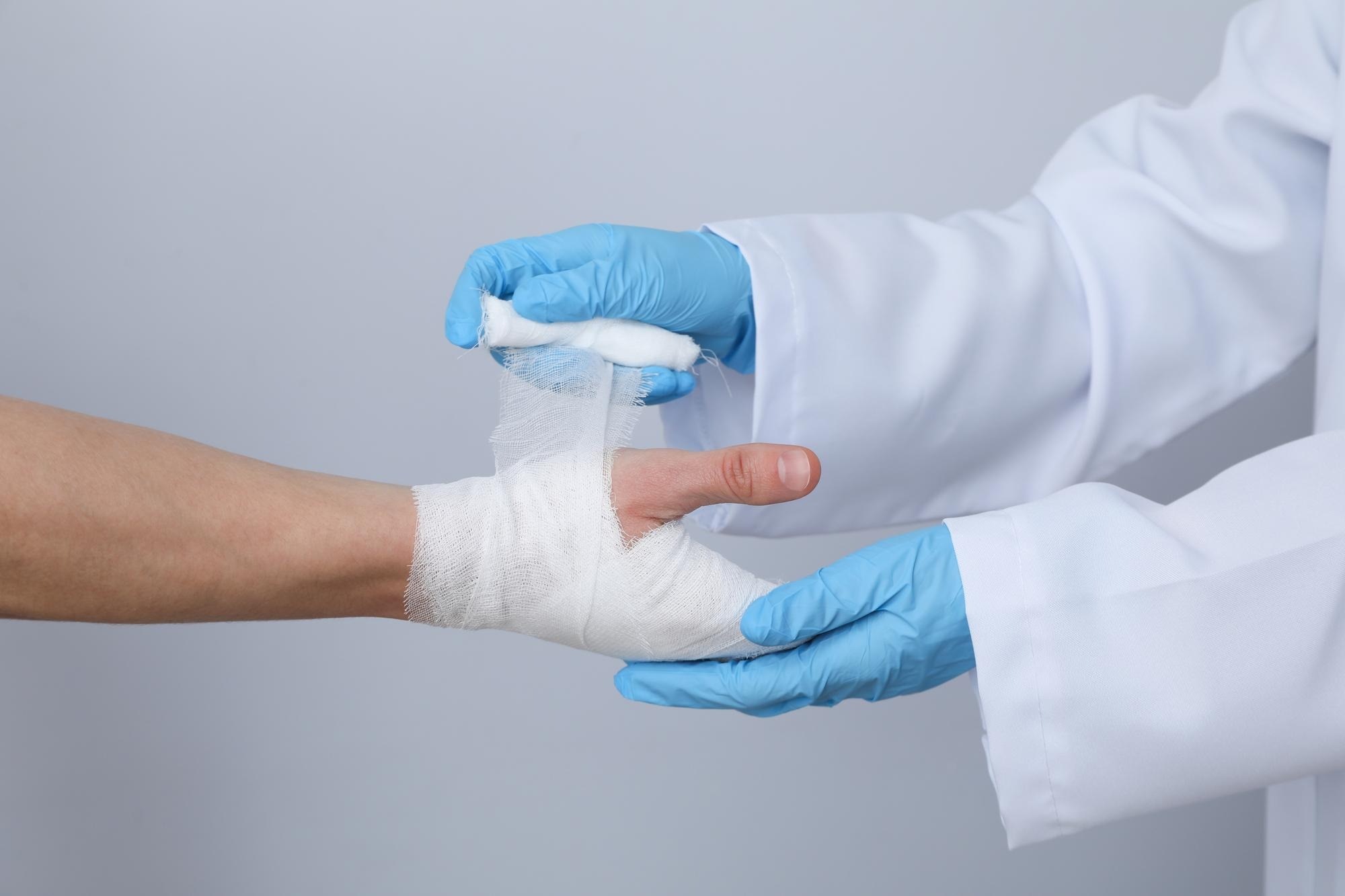
Remove rings immediately, before swelling makes them difficult or impossible to take off. Keep the hand supported in the position you found it; do not straighten a visibly bent finger, force a joint back into place, or test movement repeatedly.
- Control bleeding with steady direct pressure from clean gauze or cloth. If blood soaks through, add another layer without removing the first. Do not pull out glass or another object embedded in the wound.
- Wash a dirty, superficial wound under clean running water, then cover it with a sterile or clean dressing. Do not scrub deeply, probe the wound, or close a cut over a suspected fracture.
- Reduce swelling with a wrapped cold pack for 15 to 20 minutes at a time. Keep the pack off bare skin, and raise the hand above heart level if comfortable.
- Protect the hand with a loose dressing or padded support. Stop if the finger becomes pale, blue, cold, numb, or more painful.
A wound over a suspected fracture, visible bone, or a cut from glass or machinery needs same-day medical assessment for cleaning, tetanus review, and possible tendon or nerve damage. Seek emergency care for uncontrolled bleeding, bone protruding, or a finger that becomes blue, pale, cold, or numb.
Do not rely on skin closure or a straight-looking finger to rule out deeper injury.
Which symptoms point to a fracture, tendon, ligament or nail injury?
Arrange prompt assessment when an injury causes focal bone pain, marked swelling, bruising, deformity, or movement loss rather than soreness alone. A fall, crush, jam, or forceful bend can damage a fracture, tendon, ligament, or joint even when the finger looks straight.
| Pattern | What it suggests | What to do |
|---|---|---|
| Fingertip droops and cannot actively straighten after being forced down | Mallet finger, sometimes with an avulsion fracture | Seek prompt assessment; an X-ray may be needed |
| Fingertip cannot actively bend after the finger was forcibly straightened | Jersey finger, a flexor tendon injury involving the flexor digitorum profundus | Arrange prompt hand-surgeon assessment because delayed repair becomes harder |
| Pain, bruising, or looseness at the side of a finger after it was bent sideways | Collateral ligament injury or an associated fracture | Have the joint examined, especially if gripping is weak |
| A finger catches, locks, or remains bent after trauma | Tendon, pulley, joint, or fracture-related restriction | Do not repeatedly force it straight; arrange assessment |
| Blood covers much of the nail, the nail is split, or the nail fold is cut after a crush | Nail-bed laceration or distal-phalanx fracture | Seek clinical care; do not drill or remove the nail yourself |
A wound over a suspected fracture, visible bone, or a cut from glass or machinery needs same-day assessment for an open fracture or deeper tendon and nerve damage. Persistent focal pain, swelling, weakness, instability, or restricted motion also deserves reassessment when initial X-rays are normal.
When does a seemingly minor injury need a hand surgeon?
Arrange a hand-surgeon or orthopaedic evaluation when pain, swelling, bruising, weakness, instability or restricted motion lasts beyond 24 to 48 hours. Do this even when the finger looks straight and an initial X-ray is normal: tendon, ligament, cartilage, nerve and nondisplaced bone injuries can remain hidden.
Use this checklist:
- Gently make a loose fist without forcing the injured finger. If the finger crosses or scissors over its neighbour, suspect rotational deformity and seek prompt assessment. Rotation can impair function more than an obvious sideways bend.
- After a dislocation is put back in place, arrange dislocation follow-up even if the finger looks normal. Ligament tears, small avulsion fractures, joint-surface damage and instability can remain.
- Seek review if you cannot actively bend or straighten a finger fully, if the fingertip droops, or if the finger stays bent after trauma. A forced straightening injury followed by inability to bend the fingertip can indicate a jersey finger.
- Have a palm-side cut assessed if resisted bending causes pain or weakness. A partial flexor tendon cut can leave some movement intact while worsening with delay.
- Return for reassessment when symptoms fail to improve rather than repeatedly self-treating. A normal X-ray does not rule out an injury that needs protection, targeted rehabilitation or specialist treatment.
What can specialist assessment change about treatment and timing?
Specialist assessment can change both treatment and timing. It can separate a stable fracture, suitable for protection and supervised motion, from a displaced fracture, unstable injury, or intra-articular fracture that threatens alignment or joint movement. That distinction prevents unnecessary immobilisation while protecting against healing in a poor position.
A hand or orthopaedic specialist may recommend:
- Protection and early, supervised motion for a stable, well-aligned injury. Keeping a finger still longer than necessary increases stiffness and can delay useful hand function.
- Reduction, splinting or fixation for a displaced or unstable fracture, especially when the finger rotates, the joint surface is involved, or the fracture will not hold its position.
- Focused tendon, nerve or ligament care when weakness, numbness, instability, or loss of active movement points to soft-tissue damage. A cut tendon can develop tendon retraction, making later repair more difficult.
At Shanthi Orthopaedic And Dental Clinic, ask whether the examination has checked finger rotation, joint stability, active tendon movement and sensation before a cast or splint is chosen.
A normal first X-ray does not settle every injury. Tendon, ligament, cartilage, nerve and some nondisplaced fractures can remain hidden, so persistent focal pain, swelling, weakness or restricted motion warrants reassessment. Delaying care until malunion, scarring or stiffness develops can turn a simpler treatment plan into a longer recovery.
Related services
Orthopaedic Shanthi Orthopaedic and Dental Clinic Shanthi Orthopaedic and Dental Clinic provides professional Plaster/Cast Application for the appropriate... View service → |
Orthopaedic Shanthi Orthopaedic and Dental Clinic Shanthi Orthopaedic and Dental Clinic provides expert evaluation and comprehensive care for patients who may... View service → |
Frequently asked questions
Which hand and finger injuries need emergency care now?
Go to an emergency department for a blue, pale or cold finger, new numbness, uncontrolled bleeding, severe swelling or visible deformity.
What should you do in the first hours after a hand injury?
Control bleeding with direct pressure, remove rings before swelling increases, support the injured hand and apply a cold pack wrapped in cloth.
Which symptoms point to a fracture, tendon, ligament or nail injury?
Deformity, focal bone tenderness, bruising, inability to bend or straighten a finger, joint instability, severe pain under the nail or a lifted nail can indicate these injuries.
When does a seemingly minor injury need a hand surgeon?
Arrange specialist assessment when pain, swelling, weakness or restricted movement persists, or when you cannot fully bend or straighten the finger.
What can specialist assessment change about treatment and timing?
Assessment can identify injuries needing imaging, reduction, splinting, tendon or ligament repair, nail-bed treatment or timely surgery instead of observation alone.
Related service
Orthopaedic General Orthopaedic Conditions – Shanthi Orthopaedic and Dental Clinic Shanthi Orthopaedic and Dental Clinic provides comprehensive care for a wide... View service → |
Keywords