Joint preservation surgery is not one operation or a promise that joint replacement will never be needed. The right plan depends on the damaged structure, the joint’s alignment and stability, your activity goals, and what X-rays or MRI scans show; by the end, you will know what an evaluation and treatment pathway should include.
Key takeaways
- Preservation aims to delay replacement, not guarantee you will avoid it.
- Suitability depends on cartilage damage, alignment, stability, age and activity goals.
- Options range from rehabilitation and injections to cartilage or bone surgery.
- Ask for a written estimate covering surgeon, hospital, imaging, implants and rehabilitation fees.
What joint preservation surgery includes and who it can help
Joint preservation surgery is an umbrella term for procedures that protect or restore a damaged joint instead of replacing its surfaces with an artificial joint. The aim is to reduce pain, improve stability and movement, and delay or avoid joint replacement; it does not guarantee that replacement will never become necessary.
Joint preservation surgery details in Mumbai can therefore refer to different treatments for different problems. Common examples include:
- Early knee osteoarthritis, local cartilage defects and meniscus tears
- Knee ligament instability requiring reconstruction
- Hip impingement, labral tears and other hip-preservation procedures
- Leg or knee malalignment corrected with an osteotomy
- Selected ankle cartilage, ligament and alignment problems
| Approach | What it does | Typical situation |
|---|---|---|
| Preservation | Repairs tissue, restores stability or corrects alignment | Localised damage with usable joint surfaces |
| Replacement | Resurfaces the damaged joint with implants | Widespread cartilage loss and painful bone-on-bone arthritis |
Preservation is most useful when the damage is limited, the limb can be aligned, and the joint still has recoverable cartilage. A focal meniscus tear, isolated cartilage injury, early osteoarthritis or correctable deformity fits this pattern better than diffuse bone-on-bone arthritis, severe deformity or inflammatory arthritis.
The temporomandibular joint is different from the knee, hip or ankle. Jaw-joint problems require assessment by an appropriate dental, oral-maxillofacial or related specialist; orthodontic tooth movement is not a proven substitute for treating degenerative joint disease.
How a Mumbai surgeon decides whether preservation is suitable
A joint preservation surgery consultation in Mumbai should begin with your symptom history, activity or work goals, previous treatment and expectations—not an MRI report alone. The surgeon checks gait, limb alignment, range of motion, ligaments and meniscus, then reviews X-rays for joint space and alignment and MRI for cartilage, meniscus and ligament damage.
Ask these questions before choosing an operation:
- Is the damage an isolated cartilage or meniscus defect, or has arthritis spread across the joint?
- Can a realignment osteotomy correct the load on the damaged area?
- How long will crutches, a brace, restricted weight-bearing and physiotherapy last?
- When can you return to office work, driving, sport or impact activity?
- Could the joint still require replacement later? Shanthi Orthopaedic And Dental Clinic can document this decision around your examination, imaging and goals rather than the scan alone.
| Option | Findings that support it | Main trade-off |
|---|---|---|
| Preservation | Early disease, preserved joint space, isolated cartilage or meniscus damage, correctable alignment, or treatable instability | Rehabilitation can take months, and later replacement remains possible |
| Replacement | Diffuse bone-on-bone osteoarthritis, severe deformity, major joint-space loss or inflammatory arthritis | More predictable pain relief for advanced damage, but removes the damaged joint surfaces and limits future preservation options |
Age matters, but it does not decide the case alone. A younger active patient with widespread cartilage loss is not automatically a preservation candidate, while an older patient with a single correctable defect may be. The choice depends on whether the joint has a repairable problem or irreversible, widespread failure.
Related service
Orthopaedic Joint preservation procedures & surgeries Shanthi Orthopaedic and Dental Clinic Shanthi Orthopaedic and Dental Clinic provides specialized Joint Preservation Procedures & Surgeries focused on... View service → |
Treatment options: from rehabilitation to cartilage and bone surgery
Physiotherapy, activity changes and weight management are joint preservation treatment options in Mumbai, but they do not rebuild damaged cartilage. They reduce loading, improve strength and movement, and can delay surgery; injections can reduce pain temporarily without correcting a tear, unstable ligament or bone deformity.
| Option | What it does | Repairs or preserves the joint? |
|---|---|---|
| Physiotherapy and activity modification | Builds supporting muscle and reduces aggravating loads | Preserves function; does not repair structural damage |
| Injections | Uses medicines such as corticosteroid or hyaluronic acid to manage pain and inflammation | Controls symptoms; does not restore cartilage |
| Arthroscopy | Uses small instruments to inspect and treat the joint | Repair depends on the procedure; shaving damaged tissue is not cartilage restoration |
| Meniscus repair | Sutures a repairable tear and protects shock absorption | Repairs tissue when the tear pattern and blood supply allow healing |
| Cartilage restoration | Treats selected defects with procedures such as microfracture or an osteochondral graft | Repairs or replaces cartilage in suitable focal defects |
| Ligament reconstruction | Rebuilds a torn ligament with a graft | Restores stability, but requires prolonged rehabilitation |
| Osteotomy | Realigns the bone to move pressure away from damaged cartilage | Preserves the joint by correcting abnormal loading |
| Hip or ankle preservation | Treats impingement, labral damage, cartilage defects or selected instability | Can repair or protect the joint before advanced arthritis |
Meniscus removal can ease symptoms faster than repair, but it removes shock-absorbing tissue and can increase later cartilage loading. Repairs, cartilage procedures and osteotomies demand months of rehabilitation, and none guarantees that replacement will never be needed.
What the operation and recovery process involve
The process starts with a final review of MRI or X-ray findings, the planned procedure, anaesthesia, expected restrictions and realistic recovery milestones. Ask how long you will need crutches or a brace, when you can drive, return to desk work or sport, and what happens if preservation does not relieve symptoms.
1. Before surgery, complete blood tests or other medical checks requested by the hospital, disclose medicines and allergies, arrange transport, and follow fasting instructions. Stop or adjust medicines only when the surgical and anaesthesia teams tell you to.
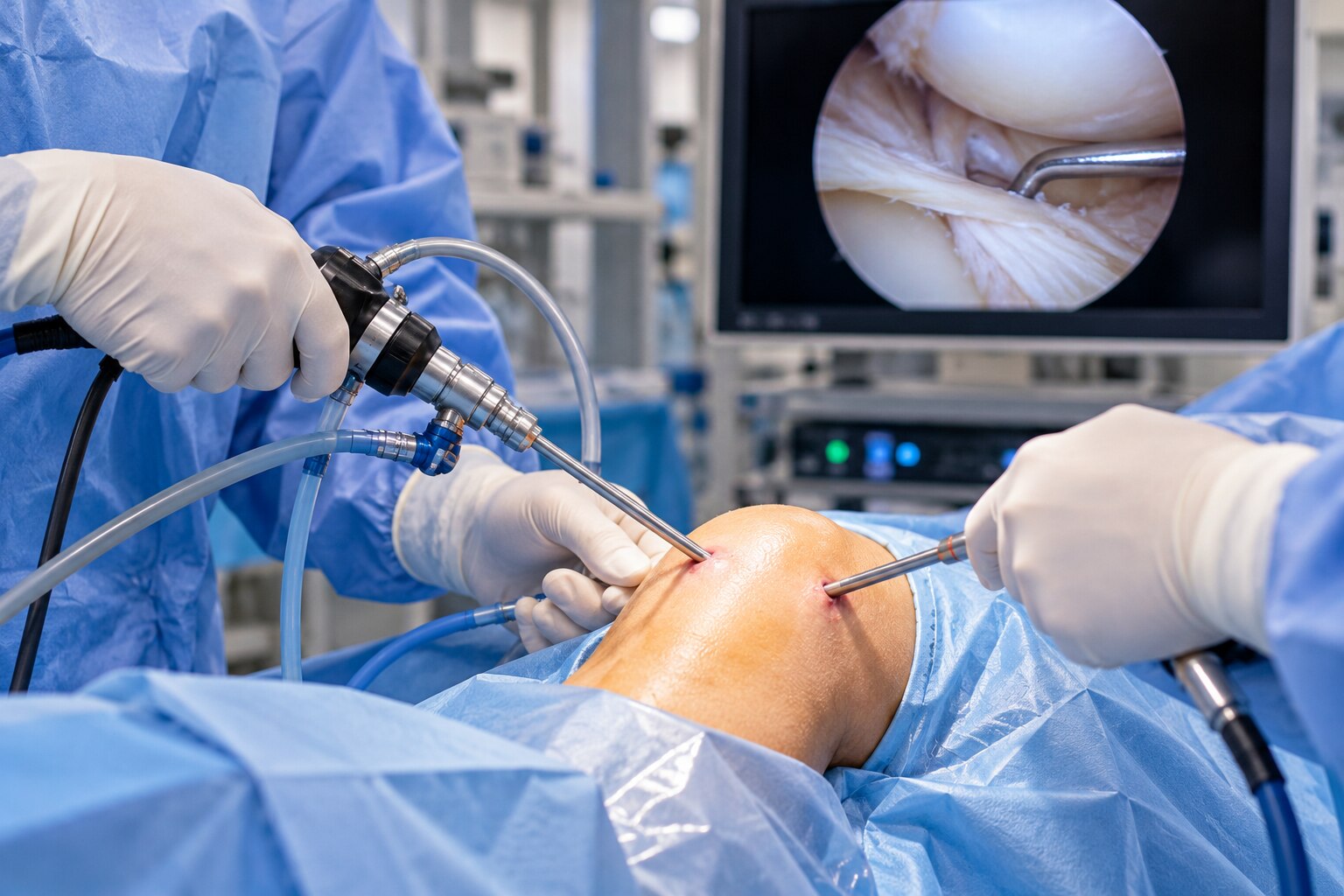
2. During arthroscopy, the surgeon uses small portals to inspect the joint and may trim or repair a meniscus, treat cartilage, or reconstruct a ligament with a graft. Osteotomy is different: the surgeon cuts and realigns bone, then secures it with plates, screws or another fixation device.
3. Immediately afterwards, you receive wound-care instructions, pain control and a plan for ice, brace use and weight-bearing. You may leave the same day after arthroscopy or stay longer after reconstruction, cartilage work or osteotomy.
4. Recovery follows a staged physiotherapy programme. Early exercises protect the repair and restore movement; later strengthening rebuilds control and load tolerance. Advancing too quickly can damage a graft or fixation, while avoiding therapy can leave stiffness and weakness.
Contact the surgical team for fever, increasing redness, drainage, calf swelling, severe pain or new numbness. Cartilage procedures and osteotomies often require months before impact activity, even when the incisions look healed.
Costs, expected outcomes and when replacement may be more appropriate
The joint preservation procedure cost in Mumbai has no single tariff. The joint and operation matter most: arthroscopy often costs less than osteotomy or cartilage grafting, while donor grafts, cell-based implants and specialised fixation increase the bill.
Ask for a written estimate separating surgeon, hospital, anaesthesia, implants or grafts, disposable equipment, imaging, admission, physiotherapy and injections. Confirm whether braces, rehabilitation and revision surgery are excluded.
| Option | Cost pattern | Likely role |
|---|---|---|
| Arthroscopy or meniscus repair | Usually lower than bone realignment or grafting | Treats selected tears or cartilage defects |
| Osteotomy or cartilage restoration | Higher because of fixation, grafts and longer rehabilitation | Corrects alignment or focal cartilage loss |
| Joint replacement | Separate quotation with implant and admission costs | Replaces a severely damaged joint |
Assess results by function, not just an X-ray. Track pain during specific activities, walking distance, range of motion, stability, strength, sleep, work and sport participation. The consultation should also set targets for weight-bearing, driving, office work and impact activity; cartilage repair and osteotomy can require months of rehabilitation.
Replacement becomes more suitable when X-rays show diffuse bone-on-bone arthritis, severe deformity or major joint-space loss, or when inflammatory arthritis affects the joint. Preservation is less predictable with widespread cartilage damage, persistent instability or pain across the whole joint. Ask how likely later replacement remains before choosing an operation designed to delay it.
For jaw-joint symptoms, seek TMJ assessment separately from knee, hip or ankle surgery.
Frequently asked questions
What does joint preservation surgery include?
It includes treatments that protect or restore a joint rather than replacing its surfaces, including rehabilitation, cartilage procedures, bone realignment and stability surgery.
How does a Mumbai surgeon decide whether preservation is suitable?
The surgeon reviews your symptoms, examination findings, X-rays or MRI results, cartilage damage, alignment, joint stability, activity goals and the extent of arthritis.
What are the main joint preservation treatment options in Mumbai?
Options include targeted rehabilitation, activity modification, medication or injections, cartilage repair, ligament procedures and bone realignment surgery.
What does recovery involve after joint preservation surgery?
Recovery can include pain control, protected weight-bearing, exercises, physiotherapy and follow-up scans or examinations. Timelines depend on the procedure performed.
When is joint replacement more appropriate than preservation?
Replacement may be more appropriate when arthritis affects most of the joint, pain persists despite treatment, deformity is substantial or preservation procedures are unlikely to restore useful function.
Keywords