
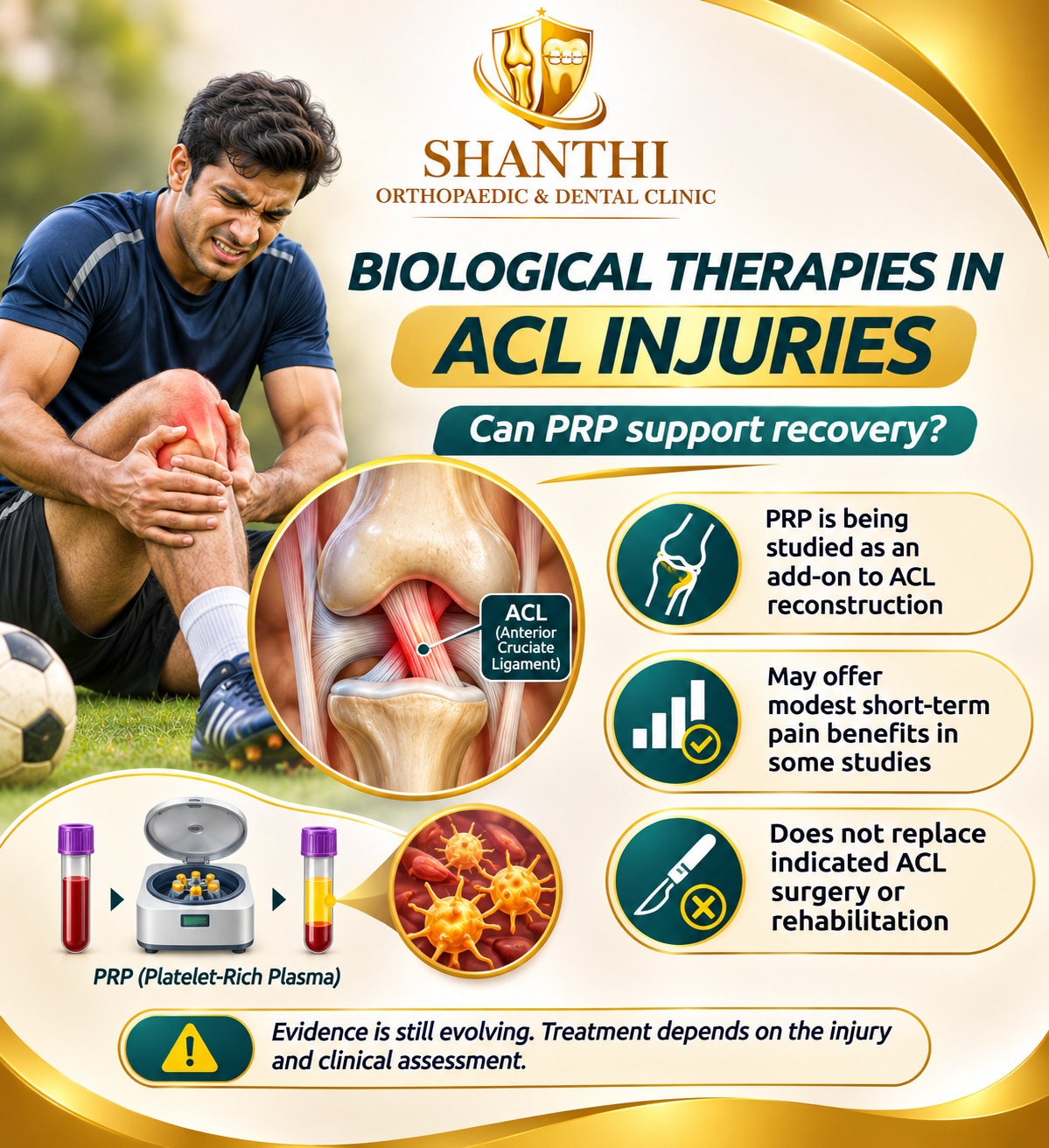
An ACL (Anterior Cruciate Ligament) injury is one of the most common sports-related knee injuries, particularly among people participating in football, cricket, badminton and other activities involving sudden twisting or direction changes.
With advances in sports medicine, biological therapies such as Platelet-Rich Plasma (PRP) and bone marrow-derived preparations are being explored as ways to support tissue healing and recovery.
But can these treatments actually heal a torn ACL?
What Are Biological Therapies?
Biological therapies use biological materials derived from the patient's own body or other biological sources with the aim of influencing tissue healing.
Some approaches being investigated in orthopaedics include:
PRP Therapy: Platelet-rich plasma is prepared from a patient's blood and contains concentrated platelets and signalling proteins.
Bone Marrow Aspirate Concentrate (BMAC): A preparation obtained from bone marrow that contains a mixture of cells and biological factors.
Cell-Based Therapies: Investigational approaches using selected cells to explore tissue repair and regeneration.
What Is Their Potential Role in ACL Injuries?
Supporting the healing environment: Biological factors may influence the local healing response.
Augmenting ACL repair: PRP and other biological materials are being studied alongside selected surgical repair techniques.
Graft healing: Researchers are investigating whether biological augmentation can influence tendon graft incorporation after ACL reconstruction.
Postoperative recovery: Some studies are examining whether biological treatments can improve aspects of recovery following surgery.
Can PRP or Stem Cells Replace ACL Reconstruction?
Important clinical distinction
Currently, biological therapies are not established replacements for ACL reconstruction in patients who require surgery because of functional instability or significant associated injuries.
A complete ACL tear does not automatically heal with PRP injections or stem cell treatment.
Treatment decisions depend on:
Type and severity of the ACL injury.
Knee instability and activity requirements.
Associated meniscus or cartilage injuries.
Age and functional demands.
Clinical examination and imaging findings.
What Does Current Research Tell Us?
Research on PRP during ACL reconstruction suggests:
Some studies report modest short-term improvements in postoperative pain.
Consistent improvement in long-term knee function has not been established.
Evidence of improved graft healing and knee stability remains inconclusive.
Routine biological augmentation is not currently supported by strong clinical evidence.
When Should You Consult an Orthopaedic Surgeon?
If you experience:
Knee instability or repeated giving-way episodes.
Swelling following a twisting injury.
Difficulty returning to sports.
Pain during running, jumping or sudden direction changes.
A proper clinical examination and MRI, when indicated, can help determine the extent of ACL damage and the appropriate treatment.
Expert Sports Injury Care in Andheri West
At Shanthi Orthopaedic & Dental Clinic, we focus on evidence-based orthopaedic care, sports injury assessment, ligament injuries and joint preservation.
👨⚕️ Dr. Ankit Mittal
M.S. Orthopaedic (Gold Medalist)
Arthroscopy, Sports Injury & Joint Replacement Surgeon
📍 Shop No. 6, Ground Floor, Opposite Navrang Theatre, J.P. Road, Andheri West, Mumbai – 400058.
📞 Orthopaedic Appointments: 9307611792
🕒 Monday–Saturday: 10 AM–2 PM | 5 PM–9 PM
Biological therapies are promising areas of research, but the right treatment begins with the right diagnosis.
#PRPTherapy #ShanthiOrthopaedicAndDentalClinic #ACLInjury #ACLReconstruction #RegenerativeMedicine #SportsInjury #Arthroscopy #LigamentInjury #DrAnkitMittal #AndheriWestMumbai #OrthopaedicCare