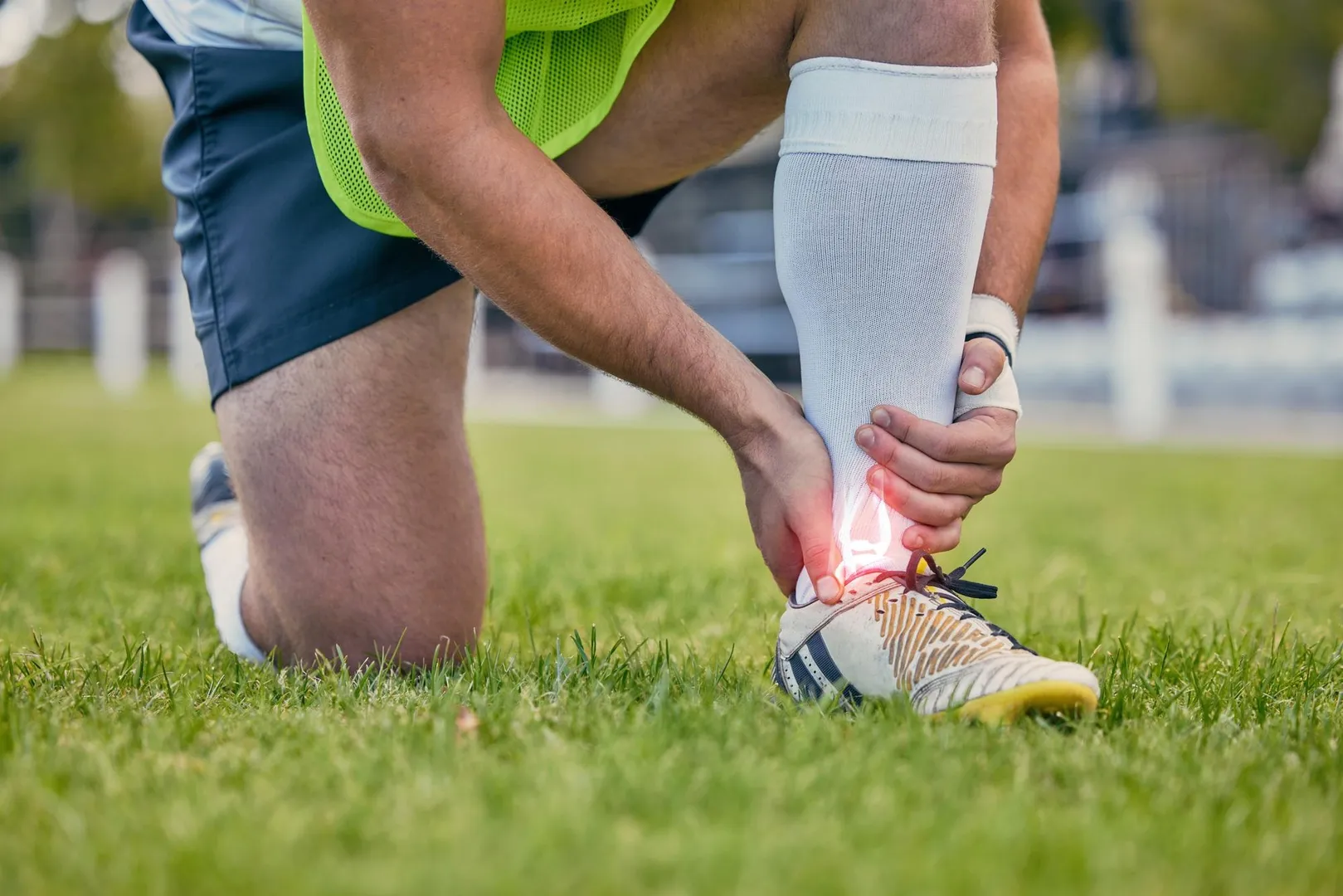
A twisted ankle, collision, sudden pain, or dental injury is not always easy to classify from appearance alone. By the end, you will be able to sort an injury into emergency care, same-day assessment, an appointment within a few days, or careful home monitoring—and know what to do before help is available.
Key takeaways
- Call emergency services for deformity, open fracture, uncontrolled bleeding, or absent circulation.
- Stop activity, protect the injury, and avoid forcing a joint back into place.
- Seek same-day care for severe pain, inability to bear weight, or worsening swelling.
- Do not return after concussion until a clinician clears a gradual progression.
Which sports-injury warning signs require emergency care now?
Go to an emergency department or call emergency services now for a sports injury emergency involving a visible deformity, an open fracture, uncontrolled bleeding, or a limb that is cold, pale, numb, or pulseless. These signs can indicate major tissue damage or blocked blood flow.
| Warning sign | Why it matters | Immediate action |
|---|---|---|
| Visible deformity or open wound over a suspected fracture | The bone may have displaced or broken through skin | Keep the limb still; do not straighten it |
| Dislocation, even after it appears to pop back | Nerves, blood vessels, cartilage, or bone may remain injured | Treat it as a dislocation emergency; do not attempt reduction |
| Severe pain out of proportion, rapidly tightening swelling, pain when muscles are passively stretched, tingling, or new weakness | These are warning signs of acute compartment syndrome, a surgical emergency | Seek emergency help immediately |
| Loss of consciousness, worsening headache, repeated vomiting, seizure, confusion, weakness, severe midline neck tenderness, chest pain, or breathing difficulty | Brain, spinal cord, heart, or lung injury may be present | Keep the person still and obtain emergency care |
Do not wait for complete numbness or loss of a pulse; both are late, dangerous findings. After a collision or fall, do not ask someone with neck pain to test neck movement. Repeatedly straightening a limb or reducing a dislocation can worsen bleeding, nerve damage, and tissue injury.
What should you do in the first minutes after an injury?
Use first aid for sports injury to prevent a second injury while you arrange evaluation. Stop play, move away from traffic, equipment, or other hazards, and do not let the athlete “walk it off.”
1. Protect the injured area with a comfortable support, such as a sling or padded wrap. Elevate an injured limb above heart level when this does not increase pain.
2. Apply a wrapped cold pack for 15 to 20 minutes. Never place ice directly on the skin.
3. Record the time and mechanism: note whether it involved a twist or direct blow, and whether you heard a pop or snap. Record the exact pain location, how quickly swelling appeared, bruising, weakness, numbness, and any change in weight-bearing or movement.
4. Do not repeatedly test painful movement, force a joint through its range, or stretch a suspected tendon injury. Do not ask someone with neck pain to test neck motion.
5. Do not manipulate a suspected dislocation, even if the joint seems to have popped back in. Keep the person still and arrange emergency help for neck pain after impact, worsening neurological symptoms, severe pain, deformity, or a limb that is cold, pale, numb, or pulseless.
These observations guide assessment; they do not diagnose the injury.
When is a sports injury a same-day problem rather than a home-monitoring problem?
A sprain versus strain, bruise, fracture, dislocation, tendon injury, and stress fracture can cause the same pain, swelling, bruising, and restricted movement. Sports fracture symptoms are not reliable for self-diagnosis: being able to walk does not rule out a fracture.
Arrange same-day assessment for:
- Inability to bear weight, severe or worsening swelling, or major restriction of movement
- Marked weakness, loss of sensation, or pain that continues to escalate
- An ankle injury meeting the Ottawa Ankle Rules: tenderness at the posterior edge or tip of either malleolus, tenderness at the base of the fifth metatarsal or navicular, or inability to take four steps both immediately and at assessment
A snap in the back of the ankle followed by difficulty pushing off or standing on tiptoe needs examination for an Achilles tendon rupture, not routine sprain care. Monitor a stable injury briefly when function is clearly improving.
Arrange an appointment within a few days if pain, swelling, bruising, weakness, or restricted movement is not clearly improving.
How should you respond to concussion, dental injury, or a facial wound?
A concussion can occur without loss of consciousness after a blow, jolt, or body impact that transmits force to the head. Remove the athlete from play and arrange assessment for sports concussion symptoms such as headache, dizziness, nausea, balance trouble, light or noise sensitivity, slowed thinking, or irritability. Do not allow same-day return to sport.
Seek emergency help for these concussion emergency signs:
- Worsening headache, repeated vomiting, seizure, increasing confusion or agitation, unusual behaviour, slurred speech, weakness or numbness, unequal pupils, or difficulty waking
- Symptoms that worsen instead of settling, even if the athlete initially seemed well
Do not tell an athlete with these signs to sleep it off. Keep them supervised while arranging emergency care.
For a knocked-out permanent tooth, hold the crown, not the root. Gently rinse visible dirt without scrubbing, reinsert it if feasible, or place it in milk or tooth-preservation solution and obtain emergency dental care; never replant a baby tooth.
A sports dental injury needs urgent assessment for a pink or red fracture spot, pain on biting, looseness, or a tooth pushed into the gum. Facial-wound warning signs include uncontrolled bleeding, a gaping cut, detached tissue, a cut crossing the lip margin, a foreign body, or suspected facial fracture.
What can an examination and scan actually show?
An orthopaedic injury assessment begins with your history: the mechanism, timing, pain location, swelling, function, and any numbness or weakness. The clinician then checks tenderness, movement, strength, stability, and circulation before deciding whether imaging will change treatment.
| Assessment | What it shows | Important limitation |
|---|---|---|
| Sports injury X-ray | Many fractures, alignment problems, and dislocations | Can miss early stress injuries and most ligament or muscle damage |
| Ultrasound for tendon injury | Some tendon or muscle tears, fluid collections, and movement in real time | Does not assess every deep structure reliably |
| MRI for stress fracture | Marrow stress injury, cartilage, ligaments, tendons, and other deep soft tissue | Takes longer and is not automatically needed |
A scan does not replace examination. For example, an X-ray can look normal during an early stress injury, while the history and point tenderness still justify activity restriction or follow-up.
Take a stable injury that needs examination to an orthopaedic outpatient service. Shanthi Orthopaedic And Dental Clinic in Andheri West can provide a local non-emergency orthopaedic or dental assessment when symptoms persist or the diagnosis remains unclear.
Go to hospital-level emergency care for deformity, a cold or pale limb, absent sensation or pulse, severe neurological signs, uncontrolled bleeding, or an open injury suggesting fracture.
When is it safe to return to sport after an injury?
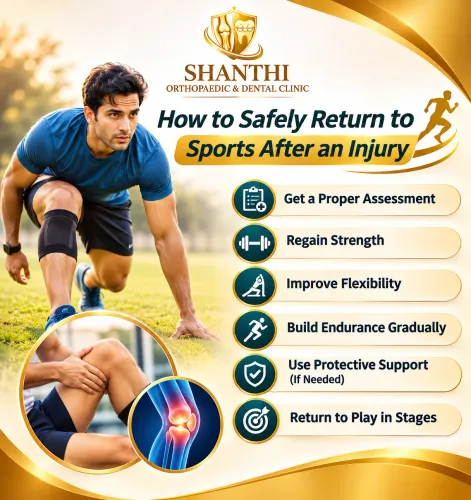
Safe return to sport after injury requires more than reduced pain. Walking normally, faded bruising, or completing one basic movement without symptoms does not prove that damaged tissue has recovered; sports injury recovery must be judged by function.
- Resume only when daily activities are pain-free, movement is near normal, strength has returned, and balance is stable.
- Test sport-specific drills next. You should complete them without pain, weakness, swelling, limping, or altered technique.
- Progress from light activity to normal training, then competition. Stop and step back if symptoms return.
A same-day return to sport is unsafe after suspected concussion, even when symptoms clear. A blow, jolt, or body impact can cause headache, dizziness, nausea, balance problems, light sensitivity, slowed thinking, or irritability without loss of consciousness.
For concussion return-to-play, follow the CDC stepwise process: each stage generally takes at least 24 hours, and progression stops when symptoms recur. A healthcare provider must approve full return. Seek reassessment if symptoms worsen, function declines, or improvement stalls; repeatedly testing the injury during play can turn a manageable injury into a longer one.
Frequently asked questions
Which sports-injury warning signs require emergency care now?
Go to an emergency department or call emergency services for a visible deformity, open fracture, uncontrolled bleeding, or a limb that is cold, pale, numb, or pulseless.
What should you do in the first minutes after a sports injury?
Stop playing, keep the injured area still, protect it from further impact, and avoid straightening a deformed joint or testing it repeatedly. Control bleeding with firm direct pressure unless an object is embedded.
When is a sports injury a same-day problem?
Arrange same-day medical assessment for severe or increasing pain, rapid swelling, inability to bear weight, reduced movement, suspected fracture, repeated joint instability, or symptoms that do not settle with rest.
How should you respond to concussion, dental injury, or a facial wound?
Remove the athlete from play after a suspected concussion and seek medical assessment; urgent care is needed for worsening headache, repeated vomiting, seizure, confusion, weakness, or loss of consciousness. For a knocked-out permanent tooth, hold it by the crown, not the root, and get urgent dental care. Apply direct pressure to a facial wound and seek care for deep, gaping, contaminated, or persistently bleeding wounds.
What can an examination and scan show after a sports injury?
An examination checks alignment, stability, range of motion, strength, sensation, and blood flow. X-rays show many fractures and dislocations; ultrasound can assess some tendons and fluid; MRI shows ligaments, cartilage, muscles, and bone marrow in greater detail.