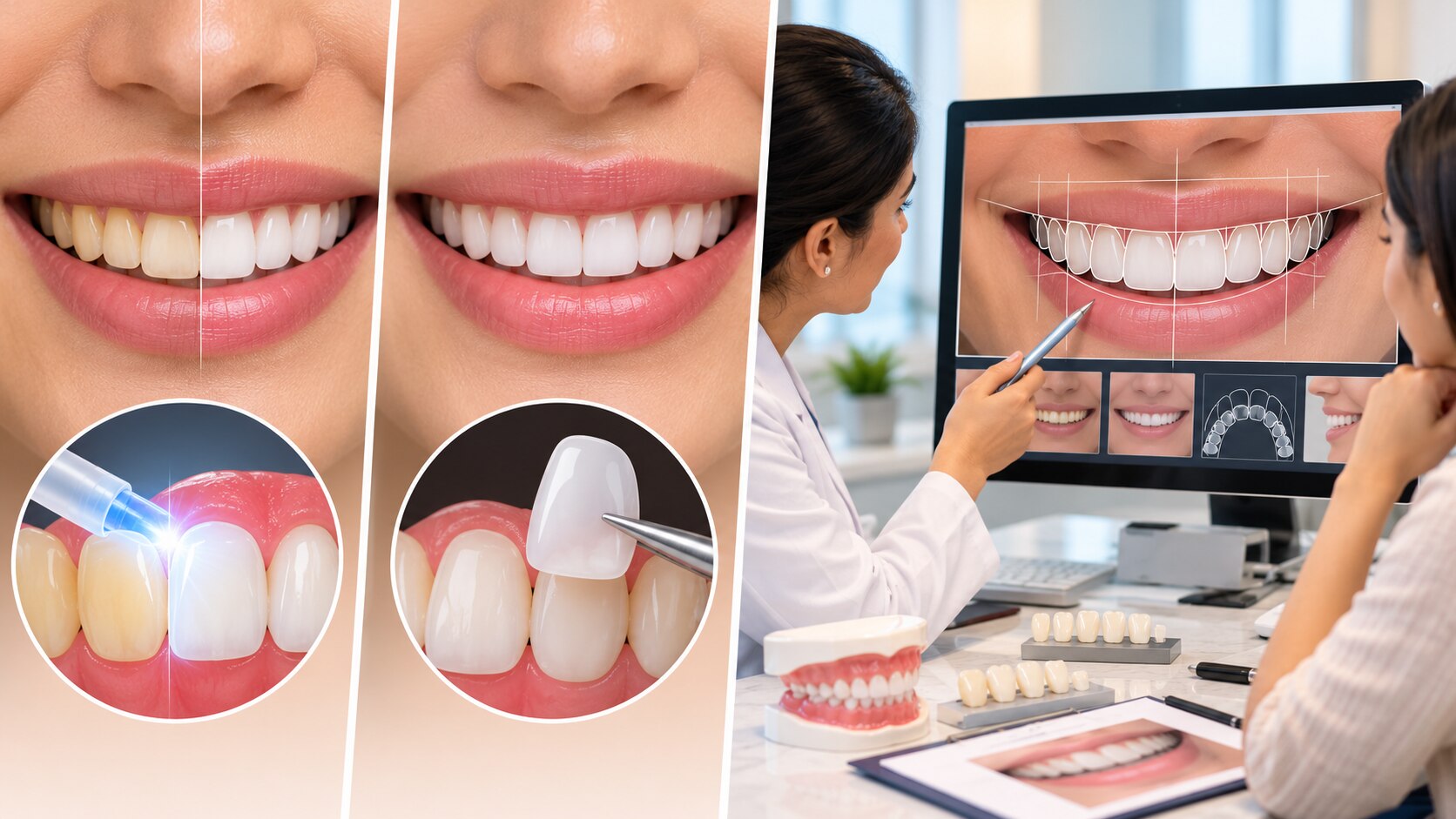
The right choice depends on whether you want to change colour, tooth shape, tooth position or the appearance of several teeth together. By comparing what bleaching, veneers and smile design actually change, you can identify the least invasive option that addresses your concern and prepare better questions for a dental consultation.
Key takeaways
- Choose bleaching for colour changes when tooth shape is already acceptable.
- Choose veneers when stains, chips or shape need a visible surface change.
- Use smile design when several treatments must work together for one result.
- Ask about tooth health, treatment longevity, maintenance and total appointments before deciding.
Start with the change you want to make
Start with the change you want: bleaching changes colour, veneers change the visible surface, and smile design coordinates several treatments to reach a broader result.
| Option | What it changes | Best fit |
|---|---|---|
| Bleaching | Breaks down stain molecules in natural teeth | Yellowing or surface stains |
| Veneers | Covers the front surface and changes apparent colour, width, length and contour | Small gaps, worn edges, minor shape differences or resistant discolouration |
| Smile design | Plans a combination of bleaching, bonding, reshaping, veneers, crowns or orthodontics | Several linked concerns requiring a coordinated sequence |
Bleaching does not alter tooth shape, size, alignment, spacing or uneven edges. It also does not lighten existing fillings, crowns or veneers, so it suits a colour-led concern rather than a structural one.
Veneers can improve selected shape problems, but they do not reposition a severely rotated or crowded tooth. Using them to disguise significant crowding, protrusion or a deep bite could remove healthy enamel when orthodontic assessment is the more suitable first step.
Smile design is a planning process, not a single procedure. For someone comparing bleaching veneers or smile design in andheri west, the decision guide is simple:
- Stains point toward bleaching.
- Shape, small gaps or uneven edges point toward veneers or bonding.
- Several visible concerns require smile design planning.
- Crooked teeth, protrusion, significant crowding or bite problems require alignment assessment.
What to expect from in-office and take-home bleaching
In-office bleaching suits a faster colour change: the dentist examines your teeth, protects your gums, applies peroxide gel and controls its contact time and exposure during a scheduled appointment.
| Option | How it works | When it fits |
|---|---|---|
| In-office bleaching | Peroxide gel is applied under gum protection while the dentist controls exposure. | You want a supervised appointment and faster visible change. |
| Take-home bleaching | Custom trays hold dentist-prescribed gel for a specified period over several days or weeks. | You prefer gradual control and fewer treatment appointments. |
Both approaches need maintenance. Natural teeth can stain again through tobacco, tea, coffee, coloured foods and normal ageing, so follow-up treatment or lifestyle changes may be needed.
Temporary sensitivity and gum irritation are the common problems. Stronger peroxide, longer contact, exposed dentine or leaking restorations increase the risk; reducing exposure or pausing treatment can help.
External bleaching responds less predictably to:
- Tetracycline staining
- Fluorosis
- Trauma-related darkening
- A non-vital tooth
After examination, internal bleaching or restorative masking may suit these cases better than repeated external treatment.
Porcelain, ceramic and composite restorations do not lighten. If you plan veneers, crowns or bonding after teeth bleaching in Andheri West, select their shade after natural teeth stabilise; otherwise the restoration may not match later.
When veneers solve a shape problem that bleaching cannot
Veneers solve shape problems that bleaching cannot: they cover the front of a tooth to change its apparent width, length, contour and colour. That makes them relevant to small gaps, worn edges, uneven shapes or discolouration that does not respond predictably to bleaching. They do not reposition a severely rotated or crowded tooth.
Porcelain veneers provide a laboratory-made, glass-like surface with stable colour. Composite veneers are shaped and bonded directly or indirectly; they are easier to repair or modify, but can stain, chip and wear differently from porcelain.
Conventional porcelain treatment usually removes some enamel to create space and a reliable bonding surface, so it is generally irreversible. A “minimal-preparation” claim does not remove the need for examination: tooth position, enamel thickness and the planned result determine whether drilling is required.
Treat veneers as a long-term restorative decision before searching for dental veneers near jp road.
1. Check decay, gum inflammation, cracked teeth, exposed dentine, active sensitivity, tooth wear and the bite first. Placing a veneer over untreated disease can conceal the problem and shorten the restoration’s service.
2. Discuss risks including chipping, fracture, debonding and marginal leakage or staining. Bruxism, nail biting, chewing hard foods, inadequate space and an unstable bite increase mechanical risk.
3. Agree on repair, replacement and maintenance arrangements. Veneers are not reversible whitening, and they do not last forever; bleaching should be completed before shade-matched restorations because porcelain and composite do not lighten later.
How smile design plans several treatments without guessing
Smile design is a planning process, not one procedure. The dentist combines an examination, photographs, digital scans or impressions, bite assessment, tooth proportions and gum display to decide whether bleaching, orthodontics, bonding, veneers or crowns belong in the plan.
1. Assess caries, leaking fillings, gum disease, enamel defects, tooth wear, occlusion and nerve symptoms. Cosmetic treatment placed over untreated disease can conceal problems and fail sooner.
2. Record the desired changes and decide whether they concern colour, shape, spacing, tooth position, gum display or bite. Significant crowding, protrusion or uneven tooth position may need orthodontic movement before cosmetic restoration, preserving healthy enamel that reshaping could remove.
3. Test the proposed appearance with a wax-up, mock-up or digital preview. This improves communication about tooth length, width and contour, but cannot guarantee the final result because lip movement, facial expression, gum levels, tooth thickness, laboratory work, bite forces and underlying tooth colour affect the outcome.
4. Set the treatment order. Bleaching often comes before shade-matched restorations when appropriate, while fillings, reshaping, bonding, veneers or crowns follow the examination findings. The material—composite, ceramic or porcelain—also affects shade planning because restorations do not whiten like natural teeth.
A search for a smile design clinic in Andheri West identifies a location, not a treatment plan. Ask which teeth are included, how much preparation is required and why the proposed sequence fits your bite and dental health.
Questions that reveal which option fits your case
Use these questions to test whether the plan addresses colour, shape, position or all three—not just the label attached to it.
| Option | Best fit | Main limitation |
|---|---|---|
| Bleaching | Colour-led yellowing or staining | Does not change shape, alignment, gaps or restorations |
| Veneers or bonding | Selected shape defects, small gaps or uneven edges | May require preparation and later repair or replacement |
| Smile design | Several linked changes needing coordinated planning | The name does not specify procedures, preparation or visit count |
Ask at the consultation:
- Which teeth are included, and will treatment change colour, shape, position or all three?
- Will material be added, or will enamel be drilled?
- Do decay, gum inflammation, cracks, exposed dentine, tooth wear or clenching need treatment first?
- Will bleaching happen before veneers, bonding, crowns or fillings so shades are matched after stabilisation?
- What happens to existing porcelain, ceramic or composite restorations that do not whiten?
- Can a trial mock-up show tooth length, width, gum display and speech before treatment?
- How will the bite be checked, and who handles repairs, replacement and maintenance?
At Shanthi Orthopaedic And Dental Clinic, these questions can help separate a cosmetic change from an alignment or bite problem that needs orthodontic assessment.
For cosmetic dental treatment in Mumbai, compare the diagnosis, amount of tooth preparation, number of visits and long-term maintenance—not the location phrase or marketing label. Choose bleaching for colour, veneers or bonding for selected shape defects, and smile design when several changes need coordinated planning.
Related service
Dental services Bleaching, Veneering, Smile designing Bleaching, Veneering & Smile Designing At Shanthi Orthopaedic and Dental Clinic, we offer personalized cosmetic dental treatments to enhance the... View service → |
Frequently asked questions
What is the difference between bleaching, veneers and smile design?
Bleaching changes natural tooth colour. Veneers cover the visible front surface to change colour, shape or minor wear. Smile design is a treatment plan that coordinates procedures such as bleaching, veneers, bonding or gum shaping.
When is bleaching a better choice than veneers?
Choose bleaching when your main concern is natural tooth colour and your tooth shape, alignment and enamel are acceptable. It does not repair chips, change tooth proportions or close every gap.
When can veneers solve a problem that bleaching cannot?
Veneers can alter the visible shape and proportion of teeth, mask some permanent discolouration, and cover selected chips or worn edges. A dentist must first check enamel, bite and gum health.
What should you ask before choosing cosmetic dental treatment?
Ask which concern each option addresses, how many appointments you need, whether enamel removal is involved, how results are maintained, and what happens if a veneer chips or bleaching sensitivity occurs.
Keywords